Sep
09
2021
--

Fin names former Twilio exec Evan Cummack as CEO, raises $20M

Work insights platform Fin raised $20 million in Series A funding and brought in Evan Cummack, a former Twilio executive, as its new chief executive officer.

The San Francisco-based company captures employee workflow data from across applications and turns it into productivity insights to improve the way enterprise teams work and remain engaged.

Fin was founded in 2015 by Andrew Kortina, co-founder of Venmo, and Facebook’s former VP of product and Slow Ventures partner Sam Lessin. Initially, the company was doing voice assistant technology — think Alexa but powered by humans and machine learning — and then workplace analytics software in 2020. You can read more about Fin’s origins at the link below.

The new round was led by Coatue, with participation from First Round Capital, Accel and Kleiner Perkins. The original team was talented, but small, so the new funding will build out sales, marketing and engineering teams, Cummack said.

“At that point, the right thing was to raise money, so at the end of last year, the company raised a $20 million Series A, and it was also decided to find a leadership team that knows how to build an enterprise,” Cummack told TechCrunch. “The company had completely pivoted and removed ‘Analytics’ from our name because it was not encompassing what we do.”

Fin’s software measures productivity and provides insights on ways managers can optimize processes, coach their employees and see how teams are actually using technology to get their work done. At the same time, employees are able to manage their workflow and highlight areas where there may be bottlenecks. All combined, it leads to better operations and customer experiences, Cummack said.
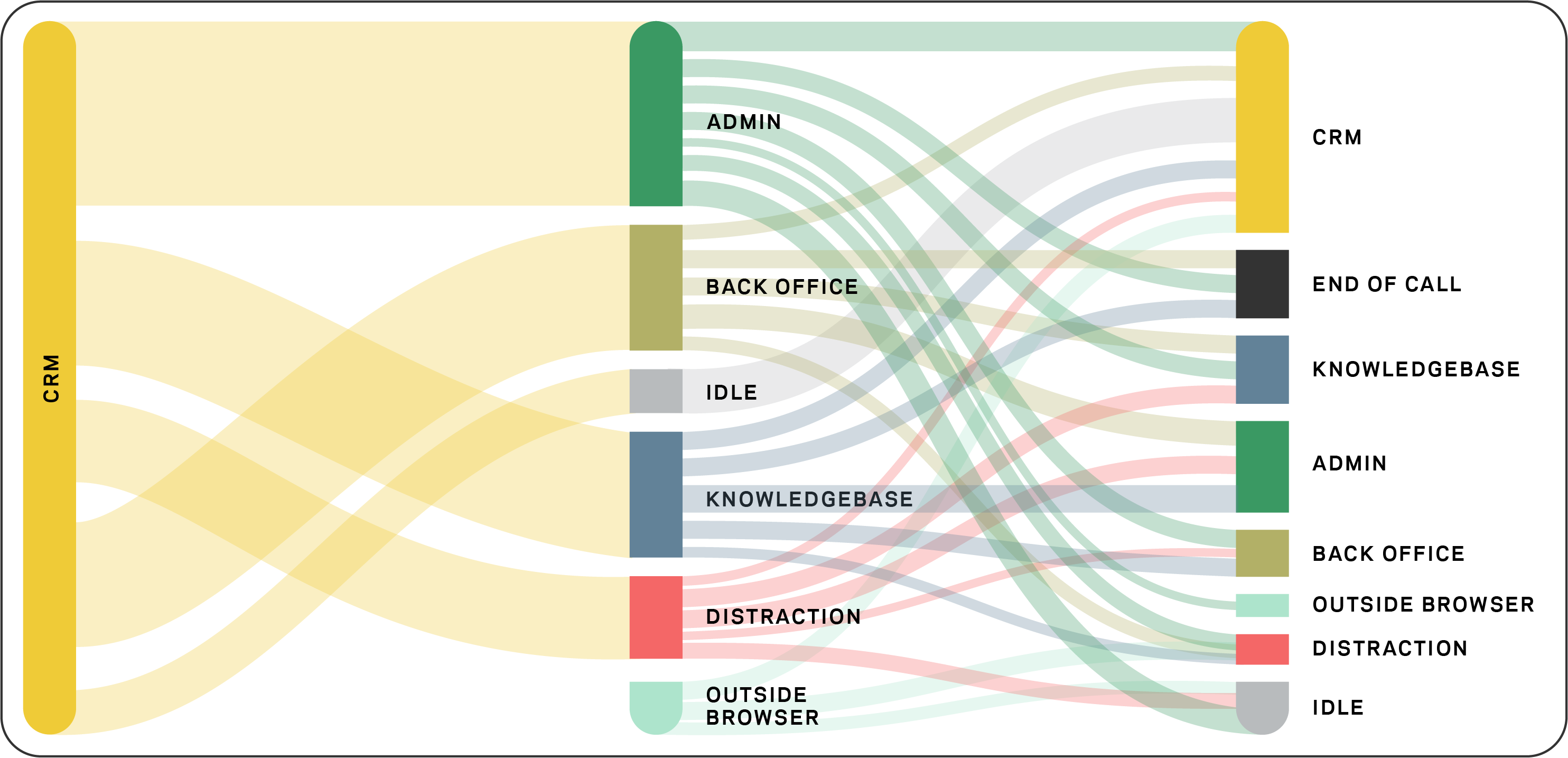
Graphic showing how work is really done. Image Credits: Fin

Fin’s view is that as more automation occurs, the company is looking at a “renaissance of human work.” There will be more jobs and more types of jobs, but people will be able to do them more effectively and the work will be more fulfilling, he added.

Particularly with the use of technology, he notes that in the era before cloud computing, there was a small number of software vendors. Now with the average tech company using over 130 SaaS apps, it allows for a lot of entrepreneurs and adoption of best-in-breed apps so that a viable company can start with a handful of people and leverage those apps to gain big customers.

“It’s different for enterprise customers, though, to understand that investment and what they are spending their money on as they use tools to get their jobs done,” Cummack added. “There is massive pressure to improve the customer experience and move quickly. Now with many people working from home, Fin enables you to look at all 130 apps as if they are one and how they are being used.”

As a result, Fin’s customers are seeing metrics like 16% increase in team utilization and engagement, a 25% decrease in support ticket handle time and a 71% increase in policy compliance. Meanwhile, the company itself is doubling and tripling its customers and revenue each year.

Now with leadership and people in place, Cummack said the company is positioned to scale, though it already had a huge head start in terms of a meaningful business.

Arielle Zuckerberg, partner at Coatue, said via email that she was part of a previous firm that invested in Fin’s seed round to build a virtual assistant. She was also a customer of Fin Assistant until it was discontinued.

When she heard the company was pivoting to enterprise, she “was excited because I thought it was a natural outgrowth of the previous business, had a lot of potential and I was already familiar with management and thought highly of them.”

She believed the “brains” of the company always revolved around understanding and measuring what assistants were doing to complete a task as a way to create opportunities for improvement or automation. The pivot to agent-facing tools made sense to Zuckerberg, but it wasn’t until the global pandemic that it clicked.

“Service teams were forced to go remote overnight, and companies had little to no visibility into what people were doing working from home,” she added. “In this remote environment, we thought that Fin’s product was incredibly well-suited to address the challenges of managing a growing remote support team, and that over time, their unique data set of how people use various apps and tools to complete tasks can help business leaders improve the future of work for their team members. We believe that contact center agents going remote was inevitable even before COVID, but COVID was a huge accelerant and created a compelling ‘why now’ moment for Fin’s solution.”

Going forward, Coatue sees Fin as “a process mining company that is focused on service teams.” By initially focusing on customer support and contact center use case — a business large enough to support a scaled, standalone business — rather than joining competitors in going after Fortune 500 companies where implementation cycles are long and there is slow time-to-value, Zuckerberg said Fin is better able to “address the unique challenges of managing a growing remote support team with a near-immediate time-to-value.”

 

Apr
30
2021
--

Developer-focused video platform Mux achieves unicorn status with $105M funding

Barely more than eight months after announcing a $37 million funding round, Mux has another $105 million.

The Series D was led by Coatue and values the company at more than $1 billion (Mux isn’t disclosing the specific valuation). Existing investors Accel, Andreessen Horowitz and Cobalt also participated, as did new investor Dragoneer.

Co-founder and CEO Jon Dahl told me that Mux didn’t need to raise more funding. But after last year’s Series C, the company’s leadership kept in touch with Coatue and other investors who’d expressed interest, and they ultimately decided that more money could help fuel faster growth during “this inflection moment in video.”

Building on the thesis popularized by a16z co-founder Marc Andreessen, Dahl said, “I think video’s eating software, the same way software was eating the world 10 years ago.” In other words, where video was once something we watched at our desks and on our sofas, it’s now everywhere, whether we’re scrolling through our social media feeds or exercising on our Pelotons.

“We’re at the early days of a five- or 10-year major transition, where video is moving into being a first-class part of every software project,” he said.

Dahl argued that Mux is well-suited for this transition because it’s “a video platform for developers,” with an API-centric approach that results in faster publishing and reliable streaming for viewers. Its first product was a monitoring and analytics tool called Mux Data, followed by its streaming video product Mux Video.

“If you’re going to build a video platform and do it data-first, you need heavy data and monitoring and analytics,” Dahl explained. “We built the data layer [and then] we built the streaming platform.”

Customers include Robinhood, PBS, ViacomCBS, Equinox Media and VSCO — Dahl said that while Mux works with digital media companies, “our core market is software.” He suggested that back when the company was founded in 2015, video was largely seen as a “niche,” or “something you needed if you were ESPN or Netflix.” But the last few years have illustrated that “video is a fundamental part of how we communicate” and that “every software company should have video as a core part of its products.”

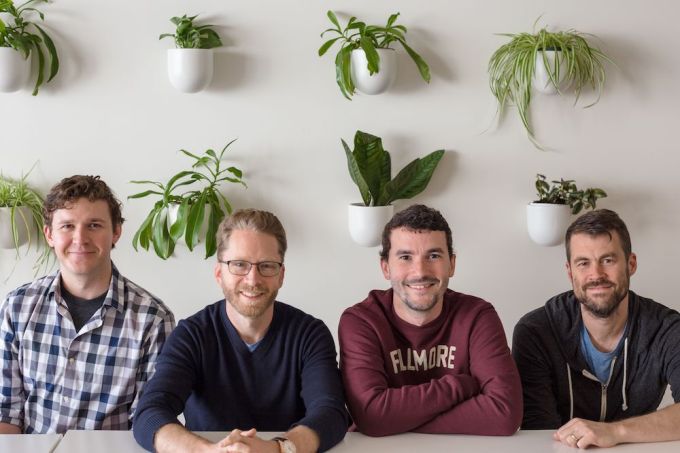
Mux founders Adam Brown, Steven Heffernan, Matt McClure and Jon Dahl

Mux founders Adam Brown, Steven Heffernan, Matt McClure and Jon Dahl. Image Credits: Mux

Not surprisingly, demand increased dramatically during the pandemic. During the past year, on-demand streaming via the Mux platform grew by 300%, while live video streaming grew 3,700% and revenue quadrupled.

“Which is a lot of work,” Dahl said with a laugh. “We definitely spent a lot of the last year ramping and scaling and investing in the platform.”

This new funding will allow Mux (which has now raised a total of $175 million) to continue that investment. Dahl said he plans to grow the team from 80 to 200 employees and to explore potential acquisitions.

“We were impressed by Mux’s laser focus on the developer community, and saw impressive customer retention and expansion indicative of the strong value their solutions provide,” said Coatue General Partner David Schneider in a statement. “This funding will enable Mux to continue to build on their customer-centric platform and we are proud to partner with Mux as it leads the way to this hybrid future.”

Nov
18
2020
--

Abacus.AI raises another $22M and launches new AI modules

AI startup RealityEngines.AI changed its name to Abacus.AI in July. At the same time, it announced a $13 million Series A round. Today, only a few months later, it is not changing its name again, but it is announcing a $22 million Series B round, led by Coatue, with Decibel Ventures and Index Partners participating as well. With this, the company, which was co-founded by former AWS and Google exec Bindu Reddy, has now raised a total of $40.3 million.

Abacus co-founder Bindu Reddy, Arvind Sundararajan and Siddartha Naidu. Image Credits: Abacus.AI

In addition to the new funding, Abacus.AI is also launching a new product today, which it calls Abacus.AI Deconstructed. Originally, the idea behind RealityEngines/Abacus.AI was to provide its users with a platform that would simplify building AI models by using AI to automatically train and optimize them. That hasn’t changed, but as it turns out, a lot of (potential) customers had already invested into their own workflows for building and training deep learning models but were looking for help in putting them into production and managing them throughout their lifecycle.

“One of the big pain points [businesses] had was, ‘look, I have data scientists and I have my models that I’ve built in-house. My data scientists have built them on laptops, but I don’t know how to push them to production. I don’t know how to maintain and keep models in production.’ I think pretty much every startup now is thinking of that problem,” Reddy said.

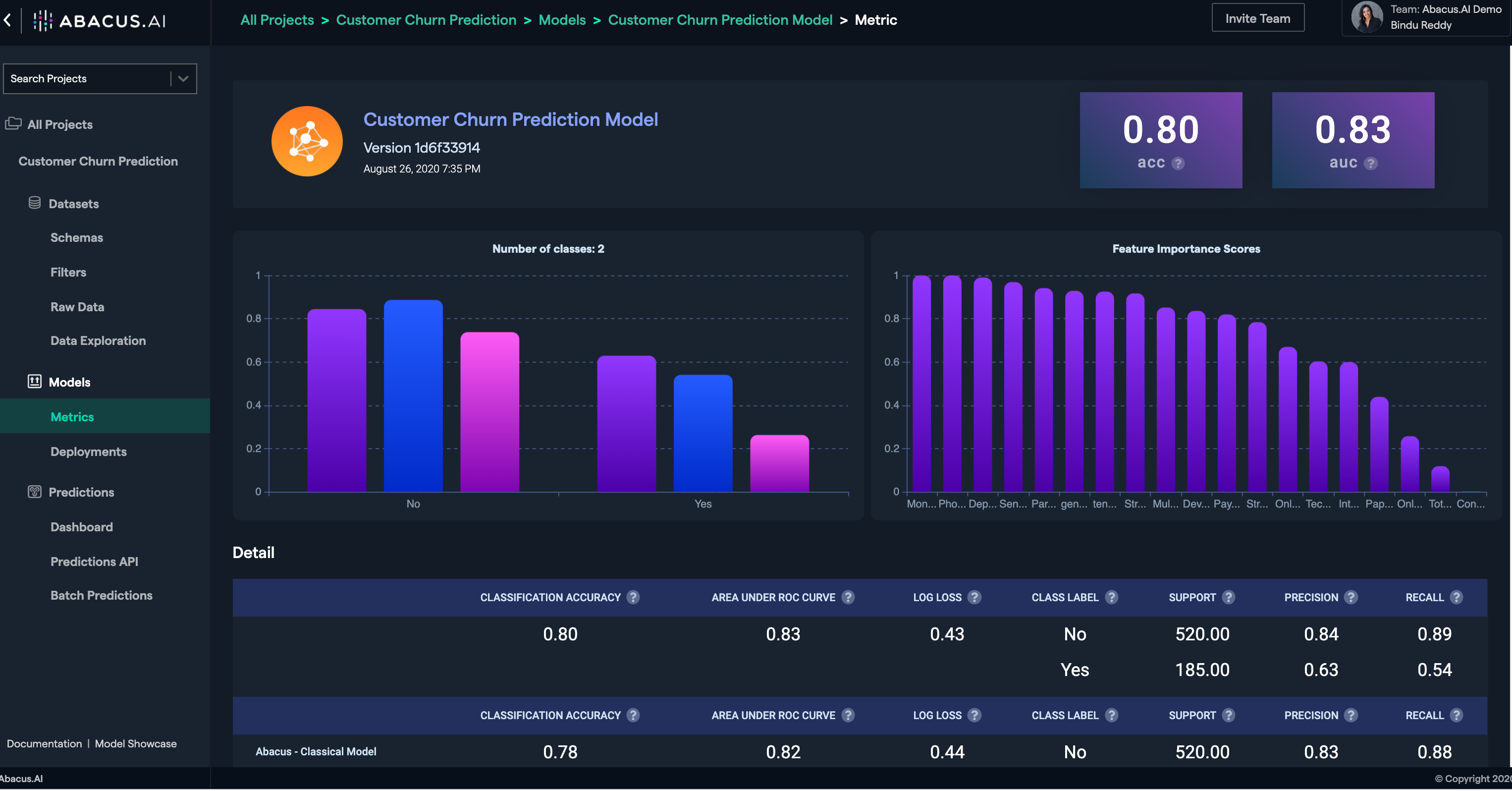
Image Credits: Abacus.AI

Since Abacus.AI had already built those tools anyway, the company decided to now also break its service down into three parts that users can adapt without relying on the full platform. That means you can now bring your model to the service and have the company host and monitor the model for you, for example. The service will manage the model in production and, for example, monitor for model drift.

Another area Abacus.AI has long focused on is model explainability and de-biasing, so it’s making that available as a module as well, as well as its real-time machine learning feature store that helps organizations create, store and share their machine learning features and deploy them into production.

As for the funding, Reddy tells me the company didn’t really have to raise a new round at this point. After the company announced its first round earlier this year, there was quite a lot of interest from others to also invest. “So we decided that we may as well raise the next round because we were seeing adoption, we felt we were ready product-wise. But we didn’t have a large enough sales team. And raising a little early made sense to build up the sales team,” she said.

Reddy also stressed that unlike some of the company’s competitors, Abacus.AI is trying to build a full-stack self-service solution that can essentially compete with the offerings of the big cloud vendors. That — and the engineering talent to build it — doesn’t come cheap.

Image Credits: Abacus.AI

It’s no surprise then that Abacus.AI plans to use the new funding to increase its R&D team, but it will also increase its go-to-market team from two to ten in the coming months. While the company is betting on a self-service model — and is seeing good traction with small- and medium-sized companies — you still need a sales team to work with large enterprises.

Come January, the company also plans to launch support for more languages and more machine vision use cases.

“We are proud to be leading the Series B investment in Abacus.AI, because we think that Abacus.AI’s unique cloud service now makes state-of-the-art AI easily accessible for organizations of all sizes, including start-ups,” Yanda Erlich, a p artner at Coatue Ventures  told me. “Abacus.AI’s end-to-end autonomous AI service powered by their Neural Architecture Search invention helps organizations with no ML expertise easily deploy deep learning systems in production.”


Aug
12
2020
--

Gong raises another $200M on $2.2B valuation

For the third time since last February, Gong has raised a significant sum. In February, the company scored $40 million. In December, it grabbed another $65 million. And today, it was $200 million on a $2.2 billion valuation. That’s a total of $305 million in less than 18 months.

Coatue led today’s cash infusion, with help from new investors Index Ventures, Salesforce Ventures and Thrive Capital, and existing investors Battery Ventures, NextWorld Capital, Norwest Venture Partners, Sequoia Capital and Wing Venture Capital. It has now raised a total of $334 million, according to the company.

What is attracting this kind of investor attention? When we spoke to Gong about its Series B round, it had 300 customers. Today it has around 1,300, representing substantial growth in that time period. The company reports revenue has grown 2.5x this year alone.

Gong CEO Amit Bendov says his company is trying to create a category they have dubbed “revenue intelligence.” As he explains it, today sales data is stored in a CRM database consisting of descriptions of customer interactions as described by the salesperson or CSR. Gong is trying to transform that process by capturing both sides of the interaction, then, using artificial intelligence, it transcribes and analyzes those interactions.

Bendov says the pandemic and economic malaise has created a situation where there is a lot of liquidity in the market and investors have been looking for companies like his to invest some of it.

“There’s a lot of liquidity in the market. There are very few investment opportunities. I think the investment community was waiting a little bit to see how the market shakes out […] and they are betting on companies that could benefit long-term from the new normal, and I think we’re one of them,” Bendov told TechCrunch.

He says that he wasn’t looking for money, and in fact still is operating off the Series B investment, but when firms come knocking with checkbooks open and favorable terms, he wasn’t about to turn them down. “There are CEOs schools [of thought] that tell you to raise money when you can, not when you need to. It’s not very diluted at this kind of valuation and it was a very easy process. […] The whole deal closed in 14 days from term sheet to money in the bank,” he said.

Bendov said that taking the money was “pretty much a no-brainer.” In fact, he says the money gives them the freedom to operate and further legitimacy in the marketplace. “It gives us the ability to buy companies, make strategic investment, accelerate plans, and it also, especially since we cater to large enterprise customers, it gives them confidence that this company is here to stay,” he said.

With around 350 employees today, it hopes to add 100 people by the end of the year. Bendov says diversity and inclusion is a “massive priority” for the company. Among the steps they’ve taken recently is opening a recruiting hub in Atlanta to bring more diverse candidates into the company, working with a company called FlockJay to train and hire underrepresented groups in customer success roles, and in Israel where the company’s R&D center is located, helping members of the Arab community with computer science backgrounds to learn interview skills. Some of those folks will end up working for Gong, and some at other places.

While the company has grown remarkably quickly and has shown great promise, Bendov is not thinking ahead to an IPO just yet. He says he wants to grow the company to at least a couple of hundred million dollars in sales, and that’s two to three years away at this point. He certainly has plenty of cash to operate until then.

Powered by WordPress | Theme: Aeros 2.0 by TheBuckmaker.com