Apr
28
2021
--

Atlassian launches a Jira for every team

Atlassian today announced a new edition of its Jira project management tool, Jira Work Management. The company has long been on a journey of bringing Jira to teams beyond the software development groups it started out with. With Jira Service Management, it is successfully doing that with IT teams. With Jira Core, it also moved further in this direction, but Jira Work Management takes this a step further (and will replace Jira Core). The idea here is to offer a version of Jira that enables teams across marketing, HR, finance, design and other groups to manage their work and — if needed — connect it to that of a company’s development teams.

“Jira Software’s this de-facto standard,” Atlassian’s VP of Product Noah Wasmer told me. “We’re making just huge inroads with Jira Service Management right now, bringing IT teams into that loop. We have over 100,000 customers now on those two products. So it’s really doing incredibly well. But one of the things that CIOs say is that it’s really tough to put Jira Software in front of an HR team and the legal team. They often ask, what is code? What is a pull request?”

Image Credits: Atlassian

Wasmer also noted that even though Jira Software is specifically meant for developers, about half of its users are already in other teams that work with these development teams. “We think that [Jira Work Management] gives them the more contextually relevant tool — a tool that actually helps them accelerate and move faster,” Wasmer said.

With Jira Work Management, the company is looking at making it easier for any team to track and manage their work in what Wasmer described as a “universal system and family of product.” As company’s look at how to do remote and hybrid work, Atlassian believes that they’ll need this kind of core product to keep track of the work that is being done. But it’s also about the simple fact that every business is now a software business and while every team’s work touches upon this, marketing and design teams often still work in their own silos.
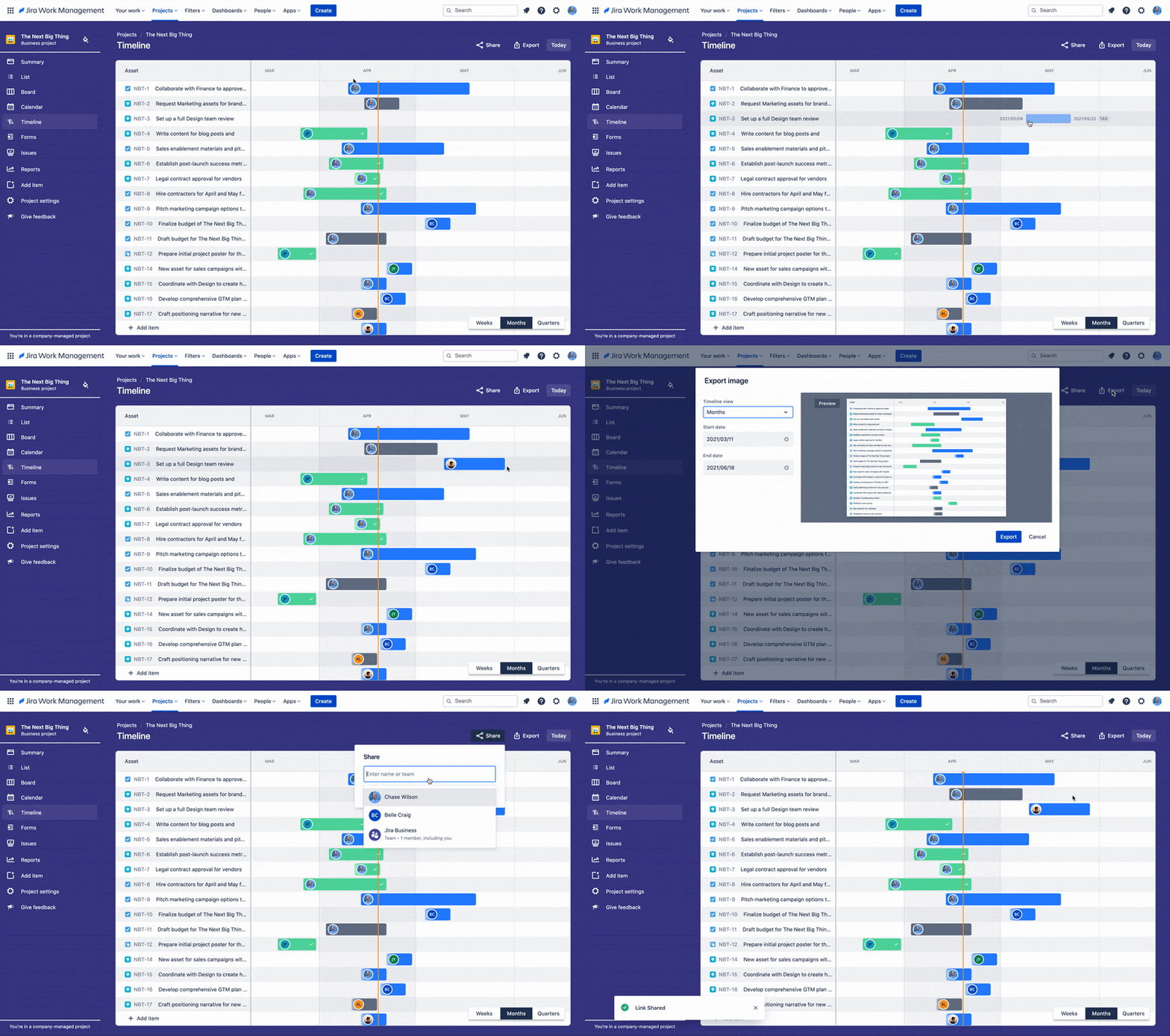
Image Credits: Atlassian

These different teams, though, also have quite different expectations of the user interface they need to manage their work most effectively. So while Jira Work Management features all of the automation features and privacy controls of its brethren, it is based around a slightly different and simplified user interface than Jira Software, for example.

What’s even more important, though, is that Jira Work Management offers a variety of views for teams to enter and manipulate their data. To get new users onboarded quickly, Atlassian built a set of templates for some of the most common use cases it expects, though users are obviously free to customize all these different views to their hearts’ — and business needs’ — content.

Atlassian also changed some of the language around Jira tickets. There are no “stories” and “bugs” in Jira Work Management (unless you add them yourself) and instead, these templates use words like “tasks,” “assets” (for design use cases) or “candidates” (for HR).
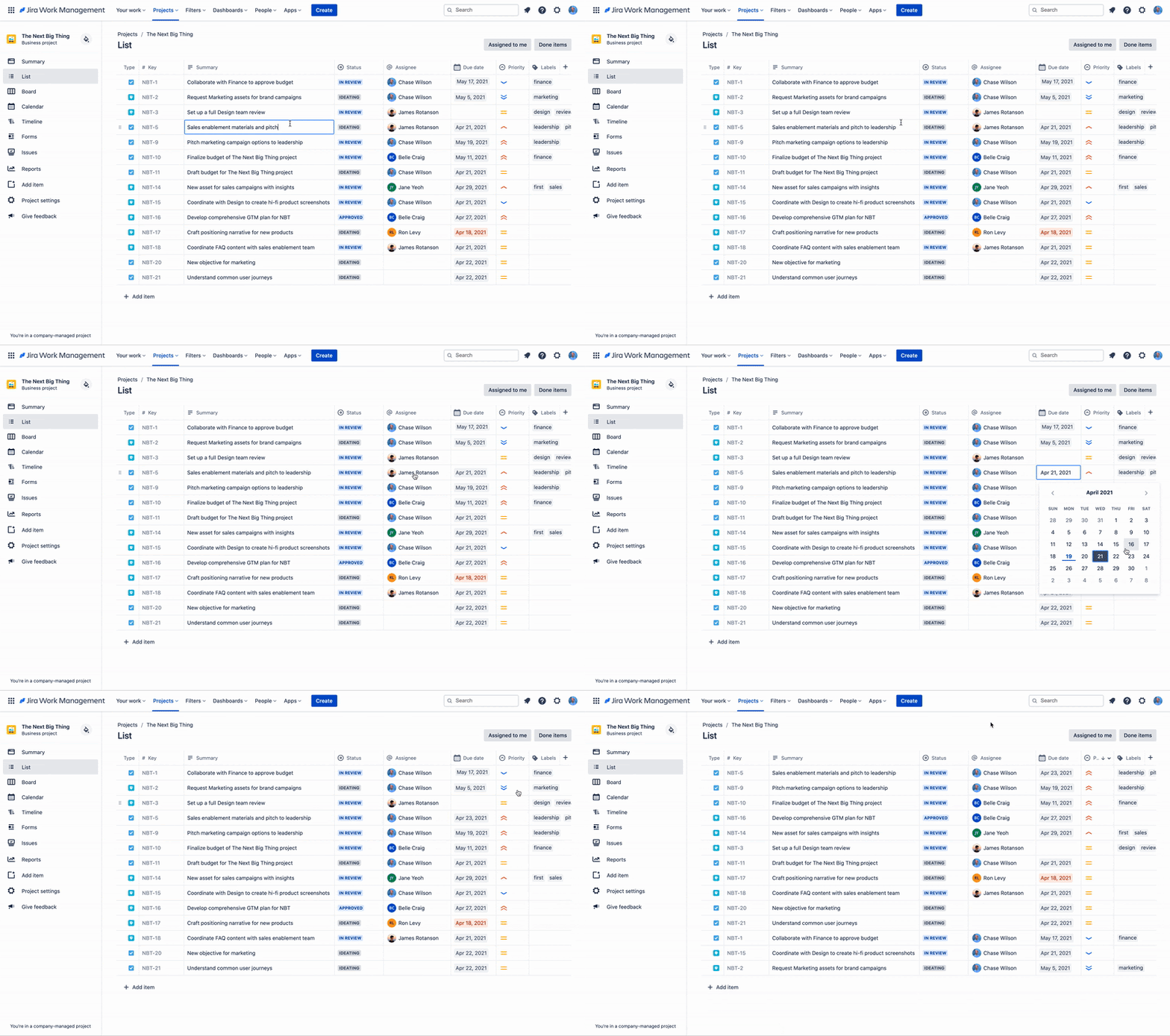
Image Credits: Atlassian

Given the fact that spreadsheets are the universal language of business, it’s maybe no surprise that the List view is core here, with an Excel/Airtable-like experience that should immediately feel familiar to any business user. It’s inline editable and completely abstracts away the usual Jira ticket, even though underneath, it’s the same taxonomy and infrastructure.

“We really wanted people to walk into this product and just understand that there is work that needs to be done,” Chase Wilson, the head of product marketing for Jira Work Management, said. He noted that the team worked on making the experience feel snappy.
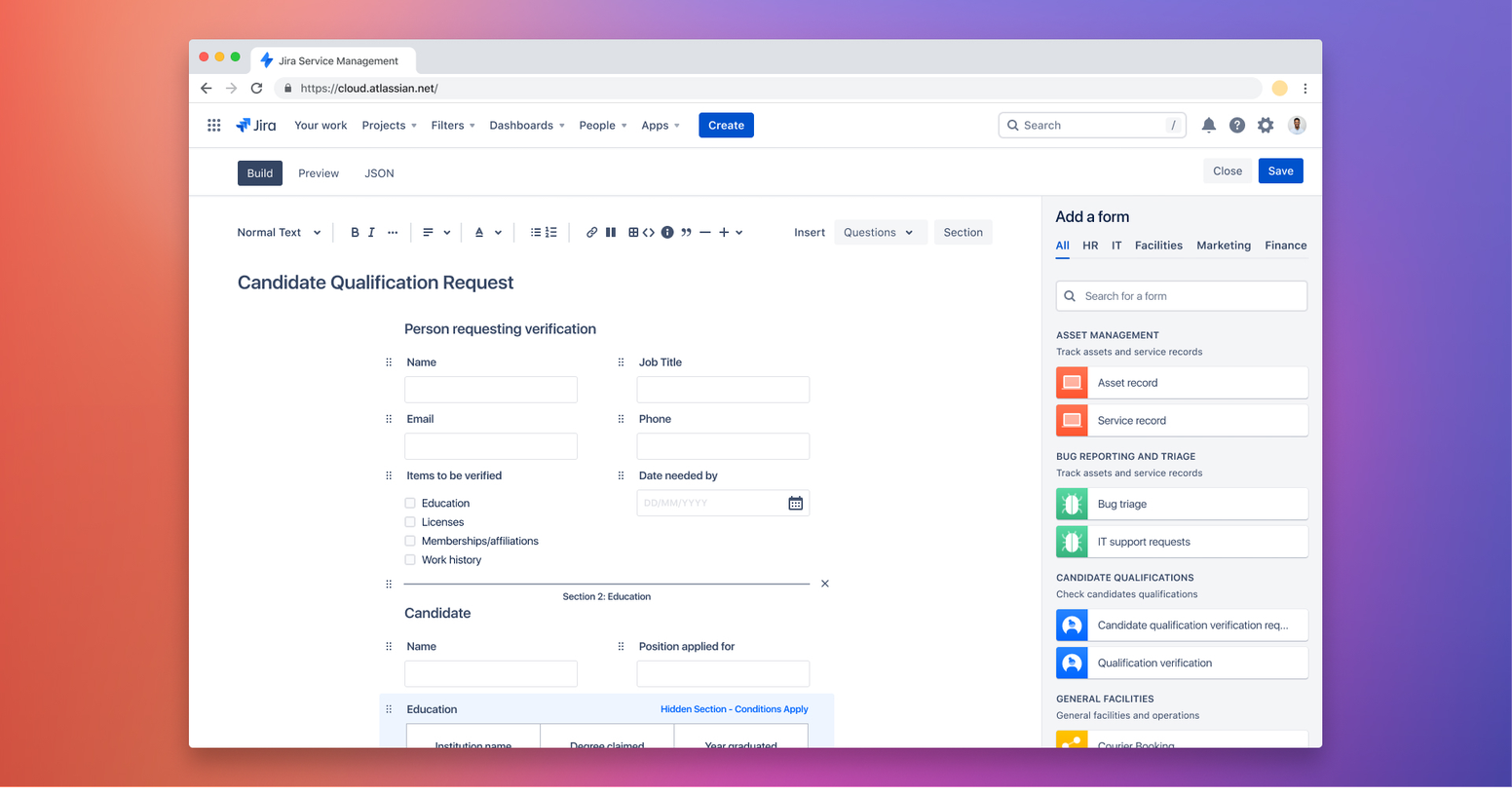
Image Credits: Atlassian

The other views available are pretty straightforward: a calendar and Gantt chart-like timeline view, as well as the traditional Kanban board that has long been at the core of Jira (and Agile in general).

Jira Work Management also lets users build forms, using a drag-and-drop editor that makes it easy for anybody inside an organization to build forms and collect requests that way. Only a few weeks ago, Atlassian announced the acquisition of ThinkTilt, the company behind the popular no-code form-builder ProForma and it looks like it is already putting this acquisition to work here.

As Wasmer stressed, Jira Work Management is meant to help different teams get work done in a way that works best for them. But because Jira is now a family of products, it also enables a lot more cross-team collaboration. That means a development team that is working on implementing a GDPR requirement can now build a workflow that ties in with the project board for a legal team that then allows legal to hold up a software release until it approves this new feature.

“We hear about this all the time today,” he said. “They just stick the legal team into Jira Software — and it over-inundates them with information that’s not relevant to what they’re trying to get done. Now we can expose them. And we also then get that legal team, that marketing team, exposed to different templates for different work. What they’re finding is that once they get used to it for that must-do use case, they start saying: Well, hey, why don’t I use this for contract approvals at the end of the quarter?”
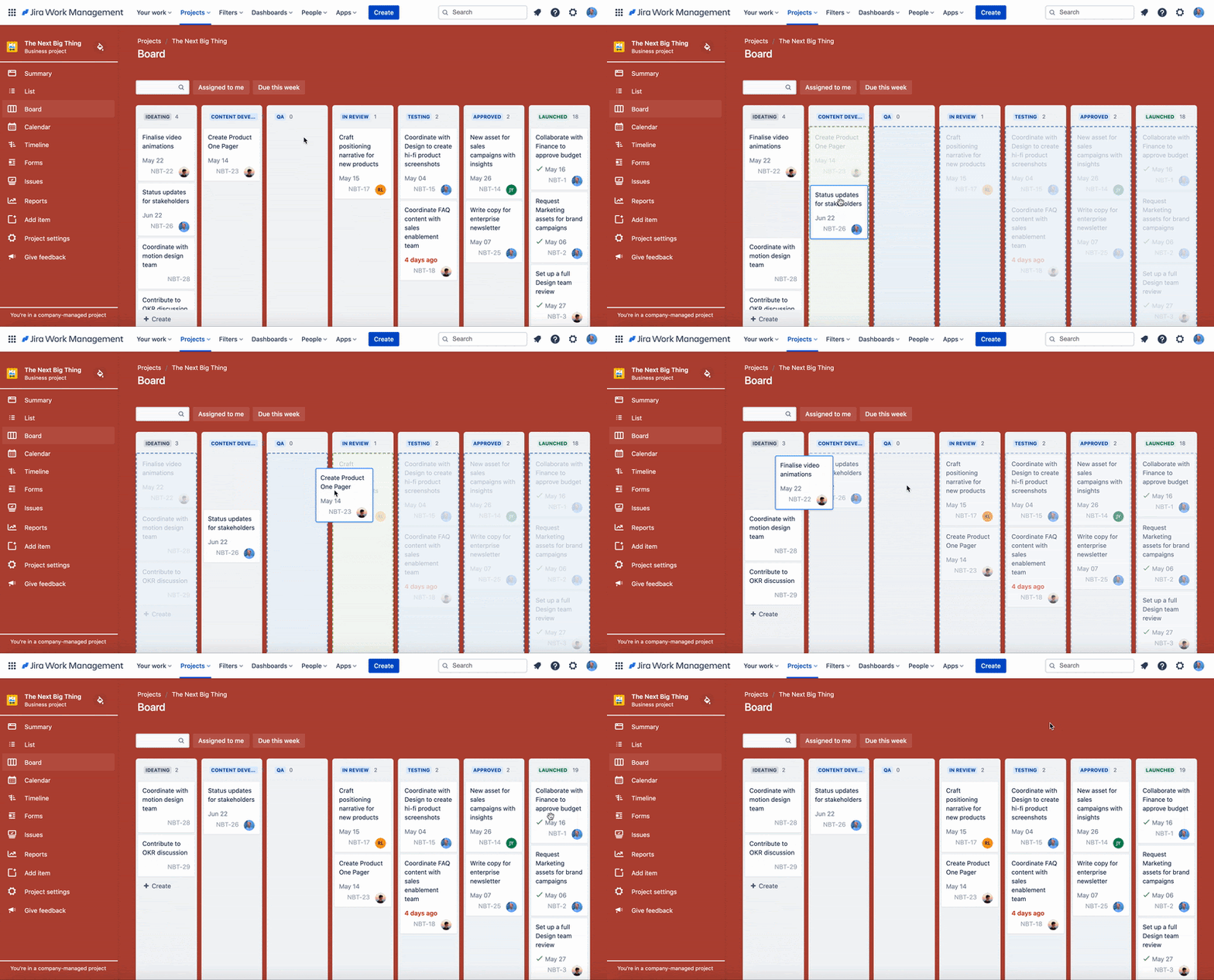
Image Credits: Atlassian

As for pricing, Atlassian follows its same standard template here, offering a free tier for teams with up to 10 users and then the paid tiers start at $5/user/month, with discounts for larger teams.

Looking ahead, Atlassian plans to add more reporting capabilities, native approvals for faster signoffs and more advanced functionality across the new work views.

It’s worth noting that Jira Work Management is the first product to come out of Point A, Atlassian’s new innovation program “dedicated to connecting early-adopter customers with product teams to build the next generation of teamwork tools.”


Mar
09
2021
--

YL Ventures sells its stake in cybersecurity unicorn Axonius for $270M

YL Ventures, the Israel-focused cybersecurity seed fund, today announced that it has sold its stake in cybersecurity asset management startup Axonius, which only a week ago announced a $100 million Series D funding round that now values it at around $1.2 billion.

ICONIQ Growth, Alkeon Capital Management, DTCP and Harmony Partners acquired YL Venture’s stake for $270 million. This marks YL’s first return from its third $75 million fund, which it raised in 2017, and the largest return in the firm’s history.

With this sale, the company’s third fund still has six portfolio companies remaining. It closed its fourth fund with $120 million in committed capital in the middle of 2019.

Unlike YL, which focuses on early-stage companies — though it also tends to participate in some later-stage rounds — the investors that are buying its stake specialize in later-stage companies that are often on an IPO path. ICONIQ Growth has invested in the likes of Adyen, CrowdStrike, Datadog and Zoom, for example, and has also regularly partnered with YL Ventures on its later-stage investments.

“The transition from early-stage to late-stage investors just makes sense as we drive toward IPO, and it allows each investor to focus on what they do best,” said Dean Sysman, co-founder and CEO of Axonius. “We appreciate the guidance and support the YL Ventures team has provided during the early stages of our company and we congratulate them on this successful journey.”

To put this sale into perspective for the Silicon Valley and Tel Aviv-based YL Ventures, it’s worth noting that it currently manages about $300 million. Its current portfolio includes the likes of Orca Security, Hunters and Cycode. This sale is a huge win for the firm.

Its most headline-grabbing exit so far was Twistlock, which was acquired by Palo Alto Networks for $410 million in 2019, but it has also seen exits of its portfolio companies to Microsoft, Proofpoint, CA Technologies and Walmart, among others. The fund participated in Axonius’ $4 million seed round in 2017 up to its $58 million Series C round a year ago.

It seems like YL Ventures is taking a very pragmatic approach here. It doesn’t specialize in late-stage firms — and until recently, Israeli startups always tended to sell long before they got to a late-stage round anyway. And it can generate a nice — and guaranteed — return for its own investors, too.

“This exit netted $270 million in cash directly to our third fund, which had $75 million total in capital commitments, and this fund still has six outstanding portfolio companies remaining,” Yoav Leitersdorf, YL Ventures’ founder and managing partner, told me. “Returning multiple times that fund now with a single exit, with the rest of the portfolio companies still there for the upside is the most responsible — yet highly profitable path — we could have taken for our fund at this time. And all this while diverting our energies and means more towards our seed-stage companies (where our help is more impactful), and at the same time supporting Axonius by enabling it to bring aboard such excellent late-stage investors as ICONIQ and Alkeon — a true win-win-win situation for everyone involved!”

He also noted that this sale achieved a top-decile return for the firm’s limited partners and allows it to focus its resources and attention toward the younger companies in its portfolio.

Jun
27
2019
--

Fellow raises $6.5M to help make managers better at leading teams and people

Managing people is perhaps the most challenging thing most people will have to learn in the course of their professional lives – especially because there’s no one ‘right’ way to do it. But Ottawa-based startup Fellow is hoping to ease the learning curve for new managers, and improve and reinforce the habits of experienced ones with their new people management platform software.

Fellow has raised $6.5 million in seed funding, from investors including Inovia Capital, Felicis Ventures, Garage Capital and a number of angels. The funding announcement comes alongside the announcement of their first customers, including Shopify (disclosure: I worked at Shopify when Fellow was implemented and was an early tester of this product, which is why I can can actually speak to how it works for users).

The Fellow platform is essentially a way to help team leads interact with their reports, and vice versa. It’s a feedback tool that you can use to collect insight on your team from across the company; it includes meeting supplemental suggestions and templates for one-on-ones, and even provides helpful suggestions like recommending you have a one-on-one when you haven’t in a while; and it all lives in the cloud, with integrations for other key workplace software like Slack that help it integrate with your existing flow.

Fellow co-founder and CEO Aydin Mirzaee and his co-founding team have previous experience building companies: They founded Fluidware, a survey software company, in 2008 and then sold it to SurveyMonkey in 2014. In growing the team to over 100 people, Mirzaee says they realized where there were gaps, both in his leadership team’s knowledge and in available solutions on the market.

“Starting the last company, we were in our early 20s, and like the way that we used to learn different practices was by using software, like if you use the Salesforce, and you know nothing about sales, you’ll learn some things about sales,” Mirzaee told me in an interview. “If you don’t know about marketing, use Marketo, and you’ll learn some things about marketing. And you know, from our perspective, as soon as we started actually having some traction and customers and then hired some people, we just got thrown into it. So it was ‘Okay, now, I guess we’re managers.’ And then eventually we became managers of managers.”

Fellow Team Photo 2019

Mirzaee and his team then wondered why a tool like Salesforce or Marketo didn’t exist for management. “Why is it that when you get promoted to become a manager, there isn’t an equivalent tool to help you with that?” he said.

Concept in hand, Fellow set out to build its software, and what it came up with is a smartly designed, user-friendly platform that is accessible to anyone regardless of technical expertise or experience with management practice and training. I can attest to this first-hand, since I was a first-time manager using Fellow to lead a team during my time at Shopify – part of the beta testing process that helped develop the product into something that’s ready for broader release. I was not alone in my relative lack of management knowledge, Mirzaee said, and that’s part of why they saw a clear need for this product.

“The more we did research, the more we figured out that obviously, managers are really important,” he explained. “70% of customer engagements are due to managers, for instance. And when people leave companies, they tend to leave the manager, not the company. The more we dug into it the more it was clear that there truly was this management problem –  management crisis almost, and that nobody really had built a great tool for managers and their teams like.”

Fellow’s tool is flexible enough to work with specific management methodologies like setting SMART goals or OKRs for team members, and managers can use pre-set templates or build their own for things like setting meeting talking points, or gathering feedback from the colleagues of their reports.

Right now, Fellow is live with a number of clients including Shoify, Vidyard, Tulip, North and more, and it’s adding new clients who sign up on a case-by-case basis, but increasing the pace at which it onboard new customers. Mirzaee explained that it hopes to open sign ups entirely later this year.

Mar
21
2019
--

HoneyBook, a client management platform for creative businesses, raises $28M Series C led by Citi Ventures

HoneyBook co-founders Oz and Naama Alon

HoneyBook, a customer-relationship management platform aimed at small businesses in creative fields, announced today it has raised a $28 million Series C led by Citi Ventures. All of its existing investors, including Norwest Venture Partners, Aleph, Vintage Investment Partners and Hillsven Capital, also returned for the round. Citi is a strategic partner for HoneyBook and this will enable it to offer new financial products to freelancers, its co-founder and CEO Oz Alon told TechCrunch.

This brings HoneyBook’s total raised so far to $72 million. It is using the funds to grow its teams in San Francisco and Tel Aviv and build new features for its user base, including small companies, people who work by themselves (“solopreneurs”) and freelancers. Like other CRMs, HoneyBook helps them develop relationships with potential new clients, manage projects, send invoices and accept payments, but with tools scaled for their business’ needs.

Alon told TechCrunch in an email that one segment HoneyBook is focused on is millennials (he cites a survey that found 49 percent of people under 40 plan to start their own business). HoneyBook currently claims tens of thousands of customers and has passed $1 billion in business booked using its software, along with 75,000 members in Rising Tide, the company’s online community for creative entrepreneurs.

Other management software platforms competing for the attention of entrepreneurs and freelancers include Tave, Dubsado and 17hats. One of the main ways HoneyBook differentiates is by enabling its users to accept online payments without integrating with a third-party service. Thanks to this, its users “transact more than 80 percent of their business online, significantly more than any other payments platform serving this audience, Alon said. Its partnership with Citi will also allow the company to develop more unique services for its target customers, he added.

In a prepared statement, Citi Ventures’ Israel director and venture investing lead Omit Shinar said, “We are in the midst of a period of extensive changes in societal structures and economic models. The fintech ecosystem is producing more and more breakthrough innovations that serve the needs of modern consumers, and we believe, as a pioneer in its space, HoneyBook can become a market leader in the U.S.”

Jul
19
2017
--

Clara Labs nabs $7M Series A as it positions its AI assistant to meet the needs of enterprise teams

 Clara Labs is announcing a $7 million Series A led by Basis Set Ventures. Slack Fund also joined in the round, alongside existing investors Sequoia and First Round. The startup will be looking to further differentiate within the crowded field of email-centric personal assistants by building in features and integrations to address the needs of enterprise teams. Read More

Feb
20
2017
--

MongoDB 3.4 Bundle Release: Percona Server for MongoDB 3.4, Percona Monitoring and Management 1.1, Percona Toolkit 3.0 with MongoDB

Percona Server for MongoDB

This blog post is the first in a series on Percona’s MongoDB 3.4 bundle release. This release includes Percona Server for MongoDB, Percona Monitoring and Management, and Percona Toolkit. In this post, we’ll look at the features included in the release.

We have a lot of great MongoDB content coming your way in the next few weeks. However, I wanted first to give you a quick list of the major things to be on the look out for.

This new bundled release ensures a robust, secure database that you can adapt to changing business requirements. It helps demonstrate how organizations can use MongoDB (and Percona Server for MongoDB), PMM and Percona Toolkit together to benefit from the cost savings and agility provided by free and proven open source software.

Percona Server for MongoDB 3.4 delivers all the latest MongoDB 3.4 Community Edition features, additional Enterprise features and a greater choice of storage engines.

Some of these new features include:

  • Shard member types. All nodes now need to know what they do – this helps with reporting and architecture planning more than the underlying code, but it’s an important first step.
  • Sharding balancer moved to config server primary
  • Configuration servers must now be a replica set
  • Faster balancing (shard count/2) – concurrent balancing actions can now happen at the same time!
  • Sharding and replication tags renamed to “zones” – again, an important first step
  • Default write behavior moved to majority – this could majorly impact many workloads, but moving to a default safe write mode is important
  • New decimal data type
  • Graph aggregation functions – we will talk about these more in a later blog, but for now note that graph and faceted searches are added.
  • Collations added to most access patterns for collections and databases
  • . . .and much more

Percona Server for MongoDBPercona Server for MongoDB includes all the features of MongoDB Community Edition 3.4, providing an open source, fully-compatible, drop-in replacement with many improvements, such as:

  • Integrated, pluggable authentication with LDAP that provides a centralized enterprise authentication service
  • Open-source auditing for visibility into user and process actions in the database, with the ability to redact sensitive information (such as user names and IP addresses) from log files
  • Hot backups for the WiredTiger engine to protect against data loss in the case of a crash or disaster, without impacting performance
  • Two storage engine options not supported by MongoDB Community Edition 3.4 (doubling the total engine count choices):
    • MongoRocks, the RocksDB-powered storage engine, designed for demanding, high-volume data workloads such as in IoT applications, on-premises or in the cloud.
    • Percona Memory Engine is ideal for in-memory computing and other applications demanding very low latency workloads.

Percona Monitoring and Management 1.1

  • Support for MongoDB and Percona Server for MongoDB
  • Graphical dashboard information for WiredTiger, MongoRocks and Percona Memory Engine
  • Cluster and replica set wide views
  • Many more graphable metrics available for both for the OS and the database layer than currently provided by other tools in the ecosystem

Percona Toolkit 3.0

  • Percona Server for MongoDBTwo new tools for MongoDB are now in Percona’s Toolkit:
    • pt-mongodb-summary (the equivalent of pt-mysql-summary) provides a quick, at-a-glance overview of a MongoDB and Percona Server for MongoDB instance
      • This is useful for any DBA who wants a general idea of what’s happening in the system, what the state of their cluster/replica set is, and more.
    • pt-mongodb-query-digest (the equivalent of pt-query-digest for MySQL) offers a query review for troubleshooting
      • Query digest is one of the most used Toolkit features ever. In MongoDB, this is no different. Typically you might only look at your best and worst query times and document scans. However, this will show 90th percentiles, and top 10 queries take seconds versus minutes.

For all of these topics, you will see more blogs in the next few weeks that cover them in detail. Some people have asked what Percona’s MongoDB commitment looks like. Hopefully, this series of blogs help show how improving open source databases is central to the Percona vision. We are here to make the world better for developers, DBAs and other MongoDB users.

Powered by WordPress | Theme: Aeros 2.0 by TheBuckmaker.com